Browser fingerprinting through Canvas and WebGL represents one of the most reliable methods websites use to track visitors. Understanding these techniques is essential for anyone working with traffic automation.
Technical Note: This article covers advanced browser internals. Basic understanding of web technologies is helpful but not required.
What is Browser Fingerprinting?
Browser fingerprinting is the practice of collecting browser and device characteristics to create a unique identifier without using cookies.
Fingerprinting vs Cookies
| Aspect | Cookies | Fingerprinting |
|---|---|---|
| Storage | Client-side | Server-side |
| Clearable | Yes | No |
| User consent | Often required | Rarely asked |
| Accuracy | Very high | High |
| Persistence | Until cleared | Permanent |
Canvas Fingerprinting Explained
How It Works
The HTML5 Canvas API allows websites to render graphics in the browser. Here's the key insight:
The Fingerprint: Due to differences in graphics hardware, drivers, and rendering engines, the exact same drawing commands produce slightly different pixel values across different systems.
The Process
- Website creates hidden canvas element
- Draws complex graphics (text, shapes, gradients)
- Extracts pixel data using
toDataURL() - Hashes the result into a fingerprint
Canvas Fingerprint Factors
| Factor | Impact |
|---|---|
| GPU model | High |
| GPU driver | High |
| OS rendering | Medium |
| Font rendering | Medium |
| Antialiasing | Medium |
Detection Accuracy
Canvas fingerprinting alone can identify:
| Browser Configuration | Unique Fingerprints |
|---|---|
| Desktop browsers | ~91% unique |
| Mobile browsers | ~85% unique |
| Same hardware | Very similar |
WebGL Fingerprinting Explained
WebGL provides even more fingerprinting opportunities through 3D graphics capabilities.
WebGL Information Exposed
Renderer Information
| Parameter | Example Value |
|---|---|
| Vendor | Google Inc. (NVIDIA) |
| Renderer | ANGLE (NVIDIA GeForce RTX 3080) |
| Version | WebGL 2.0 (OpenGL ES 3.0) |
| Shading Language | WebGL GLSL ES 3.00 |
Critical Exposure: The WebGL renderer string often reveals exact GPU model and driver version—highly unique information.
WebGL Fingerprint Methods
Method 1: Parameter Collection
Websites query dozens of WebGL parameters:
| Category | Parameters Collected |
|---|---|
| Limits | Max texture size, viewports |
| Features | Supported extensions |
| Precision | Float/int precision |
| Renderer | GPU vendor/model |
Method 2: Render Tests
Similar to canvas, websites render WebGL scenes and analyze:
- Pixel values
- Rendering precision
- Anti-aliasing patterns
- Shader outputs
Why Simple Spoofing Fails
Many tools attempt to spoof these fingerprints by:
- Returning fake renderer strings
- Adding random noise to canvas
- Blocking API access entirely
Problems with These Approaches
| Approach | Detection Method |
|---|---|
| Fake strings | Inconsistent with other signals |
| Random noise | Changes between calls |
| API blocking | Missing expected data |
Detection Reality: Sophisticated systems check for fingerprint consistency. If your canvas fingerprint changes between calls, or doesn't match your reported GPU, you're flagged instantly.
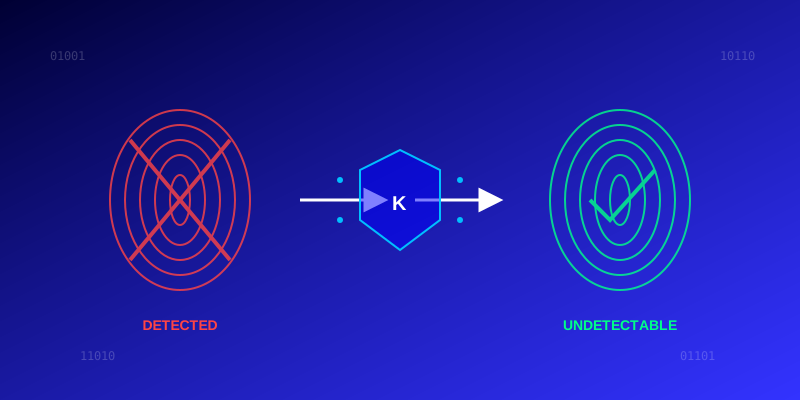
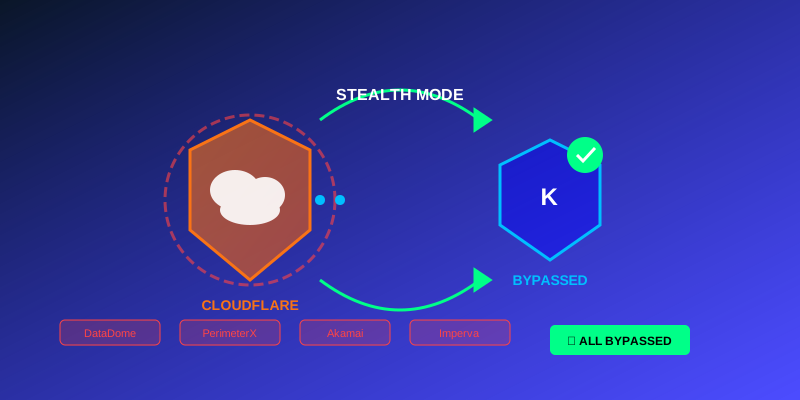
How KeLAAX Stealth Handles Fingerprinting
The Consistent Profile Approach
KeLAAX Stealth creates fingerprints that are:
Key Characteristics
| Characteristic | Implementation |
|---|---|
| Unique | 3,000+ distinct profiles |
| Consistent | Same fingerprint across all calls |
| Realistic | Based on real hardware data |
| Complete | All APIs return matching data |
Canvas Spoofing Method
Our approach injects deterministic noise based on the profile:
The Secret: Instead of random noise (detectable), we use a seeded noise pattern that produces the same result every time for that profile, but different results across profiles.
Noise Injection Process
- Profile generates unique noise seed
- Seed determines pixel-level adjustments
- Same seed = same adjustments = consistent fingerprint
- Different profile = different seed = unique fingerprint
WebGL Spoofing Method
For WebGL, we implement a more sophisticated approach:
| Component | Spoofing Method |
|---|---|
| Renderer String | Realistic GPU replacement |
| Parameters | Hardware-consistent values |
| Render Output | Seeded noise matching profile |
| Extensions | Platform-appropriate list |
Renderer String Generation
We maintain a database of real GPU configurations:
| Profile Type | Example Renderer |
|---|---|
| High-end PC | NVIDIA GeForce RTX 4090 |
| Mid-range PC | NVIDIA GeForce GTX 1660 |
| Mac | Apple M1 Pro |
| Integrated | Intel UHD Graphics 630 |
Advanced Fingerprint Consistency
Cross-API Consistency
Modern detection checks if fingerprints are consistent across APIs:
Consistency Check: If your Canvas fingerprint suggests an NVIDIA GPU but your WebGL renderer claims AMD, detection is certain.
What Must Match
| Signal | Must Match With |
|---|---|
| Canvas hash | WebGL renderer |
| GPU strings | Screen resolution |
| CPU cores | Performance benchmarks |
| Font list | OS platform |
KeLAAX Stealth's Profile System
Each profile includes coordinated values:
Complete Profile Example
| Component | Value |
|---|---|
| Canvas Hash | [Unique per profile] |
| WebGL Renderer | NVIDIA GeForce RTX 3070 |
| Screen | 2560x1440 |
| CPU Cores | 8 |
| Platform | Win32 |
| Font Count | 147 |
Testing Your Fingerprint
Recommended Testing Sites
| Site | Tests |
|---|---|
| BrowserLeaks | Comprehensive |
| AmIUnique | Comparison data |
| CreepJS | Advanced detection |
| Pixelscan | Bot detection |
What to Look For
Green Flags
- Consistent fingerprint across page loads
- Fingerprint matches profile configuration
- No JavaScript errors in console
- All APIs return realistic values
Red Flags
- Fingerprint changes between calls
- Mismatched hardware signals
- Blocked or undefined API responses
- Fingerprint matches known bot profiles
Conclusion
Canvas and WebGL fingerprinting are sophisticated tracking techniques that require equally sophisticated countermeasures. Simple spoofing approaches fail because they prioritize randomization over consistency.
KeLAAX Stealth's approach—unique, consistent, realistic fingerprints—provides the authenticity needed to avoid detection while maintaining the diversity required across multiple profiles.
Your browser fingerprint tells a story. Make sure each profile tells a believable, unique story that matches all its other characteristics.