Browser fingerprinting is one of the most sophisticated methods websites use to identify and track visitors. Understanding how it works is essential for anyone serious about undetectable traffic generation.
Did You Know? A browser fingerprint can contain over 50 unique data points, making it nearly as unique as a human fingerprint. Over 99% of browsers have a unique fingerprint.
What is Browser Fingerprinting?
Browser fingerprinting collects information about your browser and device to create a unique identifier. Unlike cookies, fingerprints can't be easily cleared and work across sessions.
Fingerprint vs. Cookies Comparison
| Aspect | Cookies | Fingerprints |
|---|---|---|
| User can delete | [Y] Yes | [N] No |
| Works in private mode | [N] No | [Y] Yes |
| Cross-browser tracking | [N] No | [Y] Partial |
| Requires consent | [Y] Yes (GDPR) | [!] Gray area |
| Accuracy | 100% | 99.5%+ |
Major Fingerprint Vectors
Understanding each fingerprint vector is crucial for defeating detection systems.
Canvas Fingerprinting
Websites draw hidden images on an HTML5 canvas element. Due to hardware and software differences, each system renders the image slightly differently, creating a unique hash.
How It Works
- Website creates an invisible canvas element
- JavaScript draws complex shapes and text
- The toDataURL() method extracts pixel data
- A hash is generated from the rendering differences
Technical Note: Even identical GPUs can produce different canvas fingerprints due to driver versions, font rendering settings, and anti-aliasing configurations.
How KeLAAX Defeats It
Our canvas spoofing injects subtle, consistent noise into canvas operations. This creates a unique but stable fingerprint that matches our profile database.
WebGL Fingerprinting
Similar to canvas, WebGL fingerprinting analyzes how your GPU renders 3D graphics. It can reveal your graphics card model and driver version.
Detected Parameters
| Parameter | Detection Method |
|---|---|
| GPU Vendor | WEBGL_debug_renderer_info |
| GPU Renderer | WEBGL_debug_renderer_info |
| Supported Extensions | getExtension() enumeration |
| Max Texture Size | getParameter() calls |
| Shader Precision | getShaderPrecisionFormat() |
How KeLAAX Defeats It
We spoof WebGL renderer and vendor strings while injecting noise into rendered output. Each profile has consistent WebGL characteristics that match real hardware configurations.
Audio Context Fingerprinting
The Web Audio API can be used to analyze how your system processes audio signals, creating another unique identifier.
The Fingerprinting Process
- Create an oscillator with specific frequency
- Process through dynamics compressor
- Analyze output with AnalyserNode
- Hash the frequency data
How KeLAAX Defeats It
KeLAAX modifies audio processing output with imperceptible noise while maintaining profile consistency.
Font Fingerprinting
By measuring which fonts are available on your system, websites can narrow down your operating system and installed applications.
Font Detection: Websites can probe for thousands of fonts in milliseconds using JavaScript. The specific combination of installed fonts creates a unique signature.
How KeLAAX Defeats It
Our profiles include curated font lists that match typical system configurations for each simulated platform.
Hardware Fingerprinting
This includes screen resolution, color depth, device memory, CPU cores, and other hardware characteristics.
Commonly Fingerprinted Hardware Details
| Property | JavaScript API |
|---|---|
| Screen Resolution | screen.width, screen.height |
| Color Depth | screen.colorDepth |
| Device Memory | navigator.deviceMemory |
| CPU Cores | navigator.hardwareConcurrency |
| Touch Support | navigator.maxTouchPoints |
How KeLAAX Defeats It
Each profile includes realistic hardware specifications based on real-world device populations. Values are consistent across sessions for the same profile.
The Importance of Consistency
Many fingerprint spoofers fail because they randomize values on every page load. This inconsistency is itself a detection signal.
Critical Insight: Randomization on every page load is a bigger red flag than having a suspicious fingerprint. Real hardware doesn't change between page loads!
KeLAAX Consistency Features
KeLAAX Stealth maintains consistent fingerprints across:
- [Y] Page navigations within a session
- [Y] Tab switches and focus changes
- [Y] Session restarts (when using the same profile)
- [Y] Form submissions and AJAX requests
Testing Your Fingerprint
Before running campaigns, always test your fingerprint configuration.
Recommended Testing Sites
| Site | Tests For |
|---|---|
| BrowserLeaks.com | All major vectors |
| CreepJS | Advanced detection |
| FingerprintJS Pro | Commercial-grade detection |
| AmIUnique.org | Uniqueness scoring |
Pre-Campaign Checklist
- [Y] Test fingerprint on detection sites
- [Y] Verify consistency across page loads
- [Y] Check WebGL and Canvas outputs
- [Y] Validate audio fingerprint stability
Conclusion
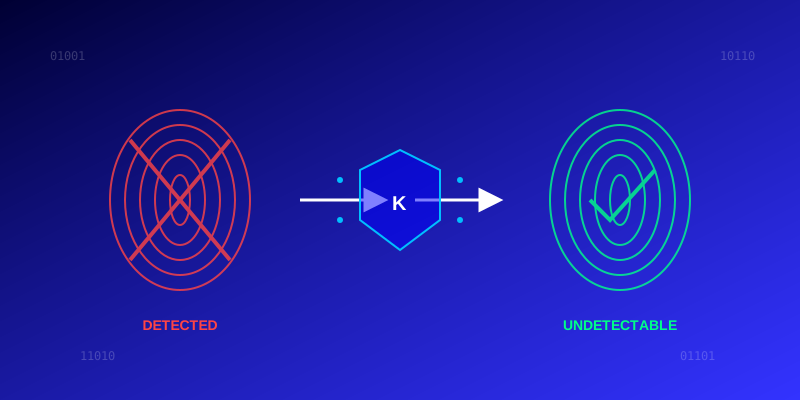
Browser fingerprinting is complex, but KeLAAX Stealth handles it automatically. With 3,000+ unique profiles and our advanced spoofing technology, your traffic will be indistinguishable from real users.
Start Testing: Download KeLAAX Stealth and run it against any fingerprint detection site. See for yourself how our technology defeats even the most sophisticated detection systems.